What to Pack for Camino de Santiago
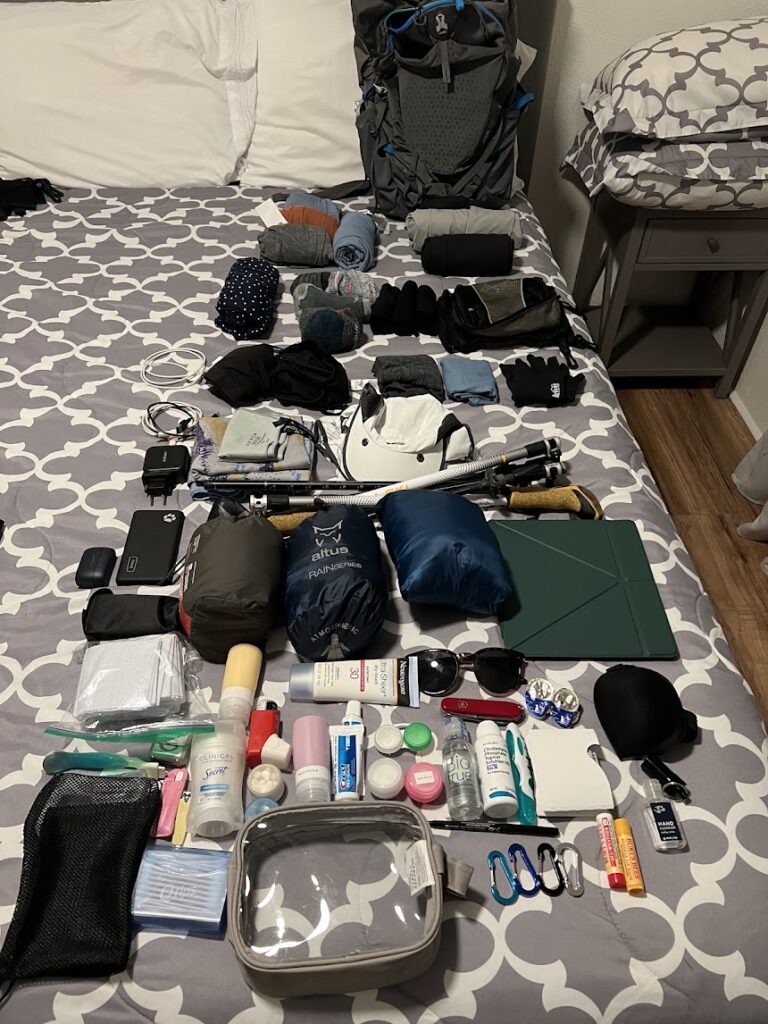
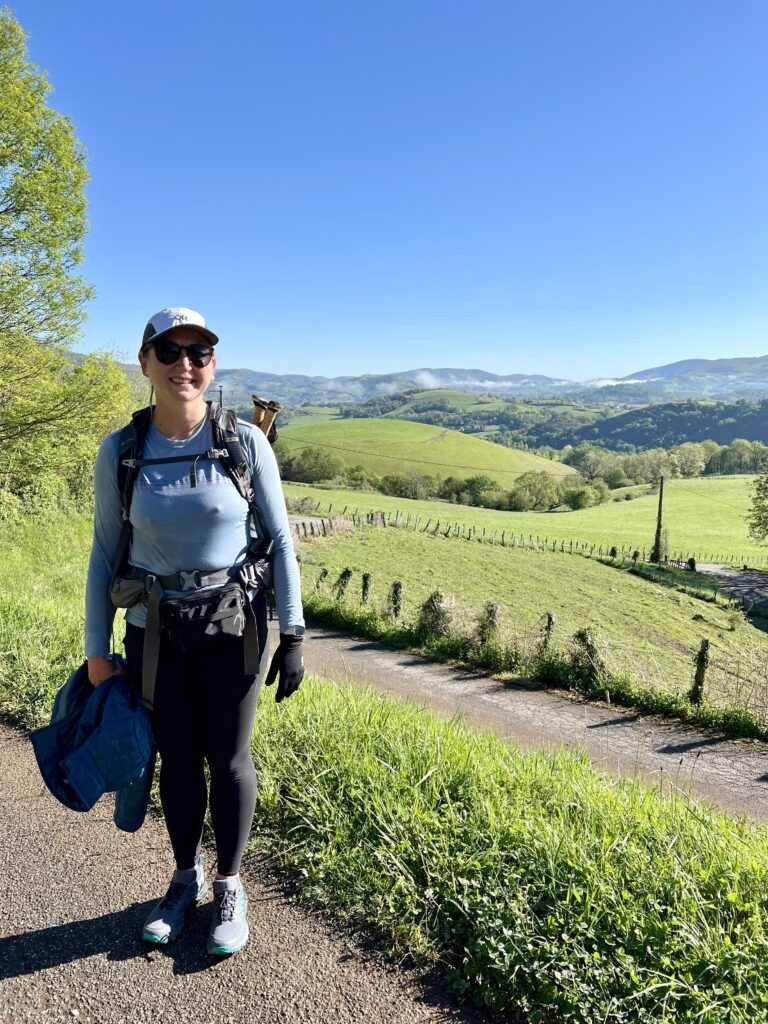
What I wore and learned during 750+ miles of Camino
Table of Contents:
- Clothing
- Shoes
- Outerwear
- Bags & Organization
- Other Important Stuff
- Toiletries
- Personal Care
- Tech Stuff
Packing for your first Camino can be super fun but also very intimidating. I dove DEEP into blogs and hiking websites, and weighed each of my items dutifully. I knew I wanted to carry my pack if I could and didn’t intend to send my pack ahead like a lot of pilgrims do (no judgement on them, everyone’s walking their own Camino!), so thoughtful packing was very important to me. I did stay in Europe after the Camino so I had a suitcase sent from Saint Jean Pied de Port to Santiago using Express Bouricot and from Porto to Santiago using Luggage Driver, which was very convenient,
Do I really need to weigh everything I bring?
Not really, but also, yes, sort of. 🙂 Having done the Camino twice now, and other backpacking, I realize that a few grams here and there between articles of clothing shouldn’t be the decision factor. It’s bringing the EXTRA stuff that’s going to weigh you down.
To Merino or Not Merino
You can’t write about clothes on the Camino without talking about Merino. I fell in line for my first Camino and bought all merino shirts and underwear and a pair of Smartwool Merino Shorts. I tried a few pants as well but they were more like long underwear and not really comfortable and very see-through. By the end of the Camino, 2 of my 3 Merino shirts had small holes in them. Luckily, I had bought them from Patagonia, and they are AWESOME. They explained that this is pretty common with the Merino shirts and they are just very fragile, and I switched them for the Capilene Cool. The underwear held up better, but I think the realization I had is that I’m too sweaty of a person to not wash my clothes after one Camino wear, so Merino is not a priority for me personally, but sweat wicking and quick dry is.
Camino Clothing:
I brought, and I’d recommend bringing, 3 complete outfits. This is fine for 5 days or for infinite days. You don’t need more than 3 outfits. I promise. 3 lets you do laundry every OTHER day instead of every day. You have something you wore that day, something you just put on when you arrived, and your dirty clothes from yesterday. And it gives extra time for stuff to dry so you don’t have to put on wet clothes.
- 3 bottoms – 2 pants and 1 shorts, or if you’re going in the summer, 2 shorts and 1 pants. Pants were the hardest thing for me to decide on my first Camino, and I regret the choice I made. I should have gone with what I feel most comfortable in and instead focused too much on the weight of my pants, ending up with some VERY lightweight but very weird looking Patagonia Fly Fishing Pants. They weighed nothing but they showed sweat and were sort of too short? That was AFTER trying on and weighing about 30 pairs of hiking pants at REI. I just don’t like hiking pants. For activity, I feel best in a pair of fitness tights. That being said, I changed my strategy entirely for my second camino and alternated between the Wunder Train and the Maipu Stash Shorts for walking, and then I’d put on my Patagonia Terrebone Joggers for the rest of the day. They are cute and comfortable and feel so light and airy. I’m obsessed with these pants.
- 3 tops – regardless of time of year, I recommend at least one long-sleeve hooded sun-shirt. During the Camino Frances, I brought 2x long sleeve and 2 short sleeve, but would now only bring 2xlong and 1x short. I actually walked that Camino in Patagonia Capilene Merino Blend shirt in short and long sleeve + a Smartwool Merino Sun Hoody. As I mentioned above, both my Patagonia Merinos had several small holes at the end, so I have now switched to the Capilene Cool line and walked my second Camino in those and did my Colorado hikes in them as well. They look brand new and dry overnight after a sink or shower handwash.
- 3 pairs of underclothes – 3 merino wool underwear and 3 bras. On my first Camino I only brought 2 bras while having 3 of everything else. It was a mistake. Being able to do laundry every other day and still have a clean outfit to wear was huge. For my second Camino, the Patagonia bras were my walking bras and then I’d switch to my Lululemon Like a Cloud after I’d showered. For the underwear, the first Camino I bought Smartwool. I liked them, and they held up longer than my Merino shirts did, but for the price, I decided to shop around and have found the Metarino from Amazon to be comparable and maybe a bit sturdier?
- Shoes – one pair of trail runners and one pair of flip flops. A lot of people bring a 3rd pair of shoes, using their flip flops exclusively for the shower, and then a pair for the evening. I rarely felt it was necessary to wear shoes in the shower. Judge if you’d like, and maybe I got lucky, but I had a lot of private baths on the Camino Frances, and otherwise felt it was low risk.
- Your hiking shoes are arguably the most important decision of the Camino and therefore subject to lots of debates. Two of the most common debates:
- Trail runners or hiking boots: Based on what I saw, trail runners have officially won this one. They’re lighter weight, they dry faster, and most of the Camino Frances (and most of the other Caminos) aren’t on terrain that needs crazy ankle support and grip.
- Waterproof or Not: This battle is still under way. I went not waterproof, and I’m glad I did. When it REALLY rains (and it did. A lot.) waterproof shoes aren’t going to keep you dry. They’re just not. You’d need rain pants, gators, and then a lot of luck. The goretex shoes were always lined up to dry overnight with the rest of them (Pro-tip: Take your insoles out and stuff with newspaper to help very soggy shoes dry overnight. Most hostels will have newspapers for this on rainy days).
- I’ve been a runner through all of my adult life, and after all the iterations of runner problems – plantar fasciitis, shin splints, etc – I found a shoe that worked for me, the Asics Gel Kayanos. I’ve been wearing them now for 15+ years, so I picked the Trabucos, the Kayanos Trail Running Counterpart. I LOVE them, they are relatively light weight, but offer good stability and support for my long-abused feet.
- For my non-hiking shoe, I wanted to let my feet breathe, but again, due to feet issues, I still needed some support, so I went with the Archie’s. They provide more arch support than regular flip flops, but come in all sorts of colors. I had to bring a specific pair of toe socks for when I needed to wear socks with these, and I’d choose a pair of slides now that they have that in their line up.
- Your hiking shoes are arguably the most important decision of the Camino and therefore subject to lots of debates. Two of the most common debates:
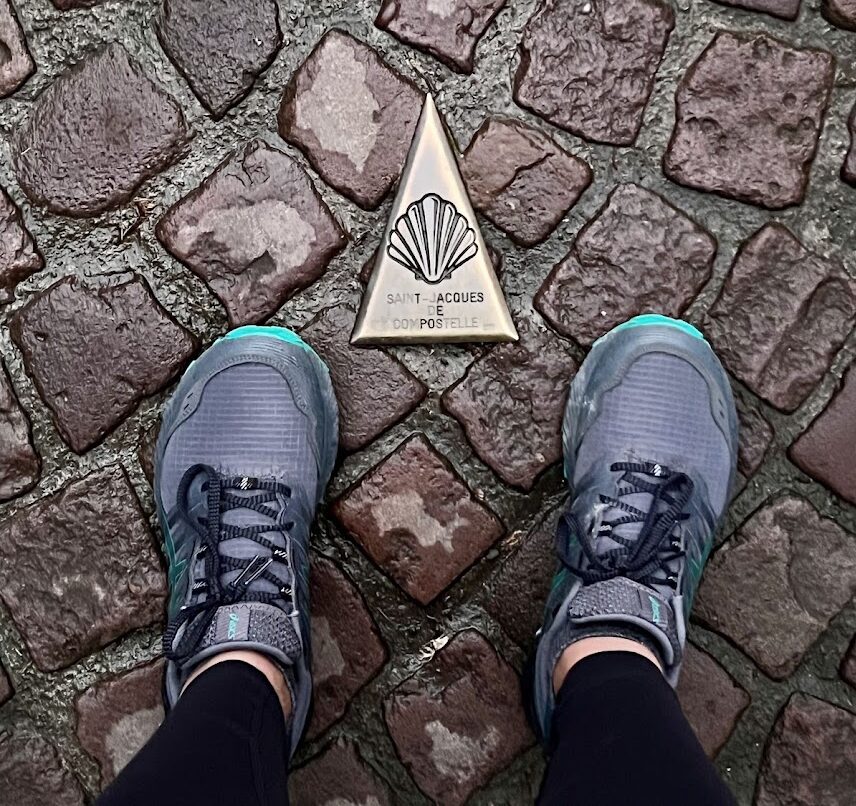
- Socks: 3 Pairs to complete my 3 outfits + a pair of Injinji toe socks to wear with my flip flops. I went with a variety of brands here, trying Darn Tough, Smartwool and Stance, and honestly feel fine about all 3. They all dried quickly overnight and seem very sturdy still. 2 long pairs and 1 short pair for the Frances, and 2 short pairs and 1 long pair for the Portuguese route.
- Hat – A must. I have never been a hat person except for fitness caps, so I went for the Outdoor research that has removable neck covers. I never once used those and opted to put my hoodie up on hot days, so probably could get by with a regular fitness hat but I liked the thought of having the sides.
- Outerwear – Coat – A lightweight packable down jacket is the general consensus for a warm layer on the Camino, and it served me well. I went with the very popular Patagonia Nanopuff. I really thought I wouldn’t use it much because I run pretty hot, and I was very very, wrong. I don’t think there were more than a few days, if that, that I didn’t wear it. The most surprising thing about this jacket was how quickly it dried. Hiking in cold temps for a sweaty person involves a vicious cycle of I’m cold –> put on jacket, –> get hot and sweaty because of jacket –> take jacket off and freeze due to being sweaty. My jacket was invariably very wet (but still warm!) and it would dry easily within a few hours. No regrets on the Nanopuff, though I am very interested in their R1 + Nano Hybrid.
- Outerwear – Superfluous Jacket: I really didn’t NEED to bring this on my second camino, but I LOVED having it. The Patagonia Houdini is SUPER lightweight, has a hood, is weather resistant and folds up super tiny. I ended up wearing it a LOT on the Portuguese Camino when it was windy but sunny or when there was a teeny bit of rain. This thing dries SO fast, I’m kind of obsessed with it.
- Outerwear – Rain Layer: Another very contested thing – rain jacket vs. poncho. I went Poncho, and the very good Atlus Camino Poncho at that. It covers your pack and you, is hooded and you can either zip or velcro it to regulate your heat. It’s expensive for a poncho but I thought it was worth it on the French Route where it rained more than 30% of the days.
- Outwear – Gloves: I wore basic REI Merino liners. They took up nearly no space/weight, and again, I wore them every day. Because I used poles everyday, my hands were always exposed and it was COLD in the mornings. I MAY consider a waterproof layer if I do another rain-likely Camino. These didn’t help a lot once wet.
- Outerwear – Buffs: Buffs kind of changed my life. I know I keep talking about how I’m a sweaty person – but it’s really actually factual and affects a lot of my clothing decisions in general, but especially on the Camino or other active trips. During a random cold day on my Camino training, I put a buff around my wrist to use on my ears if needed, but the sun came up and I ended up using it to dry my brow during the walk. I now pretty much always have a buff around my wrist when hiking/running/biking. I have used both merino wool buffs and other materials and honestly they are all light and wash/dry quickly. If anything, the merino doesn’t hold it’s elasticity well so as it’s aged I have to wrap it like 4 times. Buffs weigh nearly nothing, you can use them to cover your ears or neck for cold, or your eyes to sleep. I had one merino, one not and they both dried super fast.
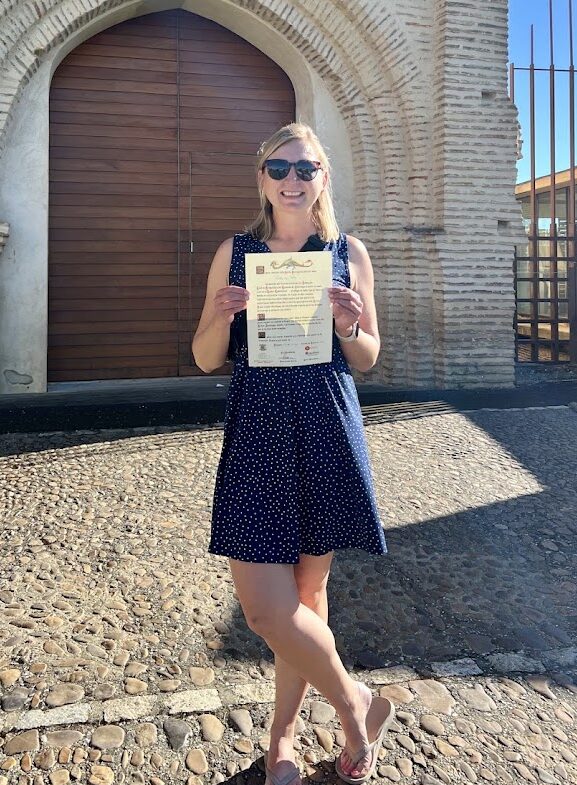
- Dress: Yes, I brought a dress on the Camino. I’m a dress gal, (and a fancy pilgrim, after all) and I wanted the option to eat at nice restaurants, or feel like the suddenly single woman I was and flirt with boy-pilgrims or Spanish locals. It weighs 7 oz, is quick dry, wrinkle free, and I did in fact wear it while my clothes laundered, to some nice dinners, and even out on a random Camino date to flirt with a pelegrino. No regrets.
Bags & Organization
- Backpack: The biggest decision of all? Probably. I tried on several fully packed at REI and I liked the look of the Gregory Jade 33 and how the women-specific design fit me. 33 Liters was on the high end of what I needed, but having the extra space was nice for when I packed a few snacks from one town to the next.
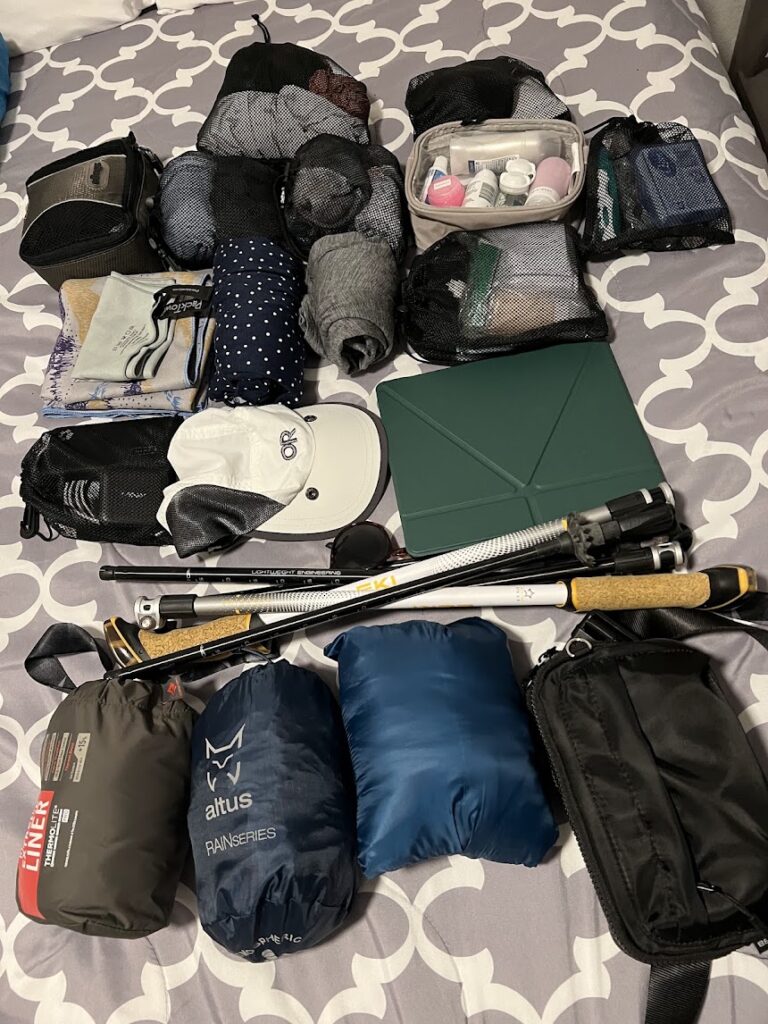
- Fanny Pack: I wasn’t sure I wanted one, and was very confused how to wear a fanny pack with a backpack with hip straps. Turns out the fanny pack just rests just below your hip straps, and it turns out I really loved having one. I ended up with this cheap one that I loved. It stored my passport and Camino credentials safely in the back pocket, the front pocket held chapstick, and the other 2 pockets held my phone, sunscreen, tissues, hand sanitizer, compeed, and cash, so much stuff! The fanny pack was ALWAYS with me, it came with me into shared shower stalls (it’s water resistant!), it was in my bed at night in dorms. One other thing I didn’t know I needed is the double zipper on the main pocket. I tried a few others with one zip, and you have to zip it all the way to keep things from falling out. With the 2 zips, I could have them both partially zipped and stuff would stay in, and it would allow easier access to my phone for the hundreds of pictures I took per day without having to worry about zipping it fully each time.
- Pack organization: I love pockets in my suitcases, purse, etc. I like organization, and I don’t love how backpacks just have a hole to put everything in. I decided on these Mesh bags to keep my things organized. If I could do it again, I would have bought a multi-color back instead of black. I’d put one outfit per bag, so I could just grab that and take it to the shower. My electronics / bed stuff (eye mask, earplugs, pills etc) were all kept in one mesh bag, so my backpack had several mesh bags to keep things organized.
Other important stuff
- Hiking Poles: The decision to hike with poles was amongst the best one I’ve made. My life is forever changed by hiking with poles and watching a few videos on how to hike correctly using poles (Hint: even though it’s not hard, you’re probably using them wrong). I went with very lightweight poles with cork handles, because a wise REI associate told me that they don’t get “soggy” like the foam handles do from sweat or rain.
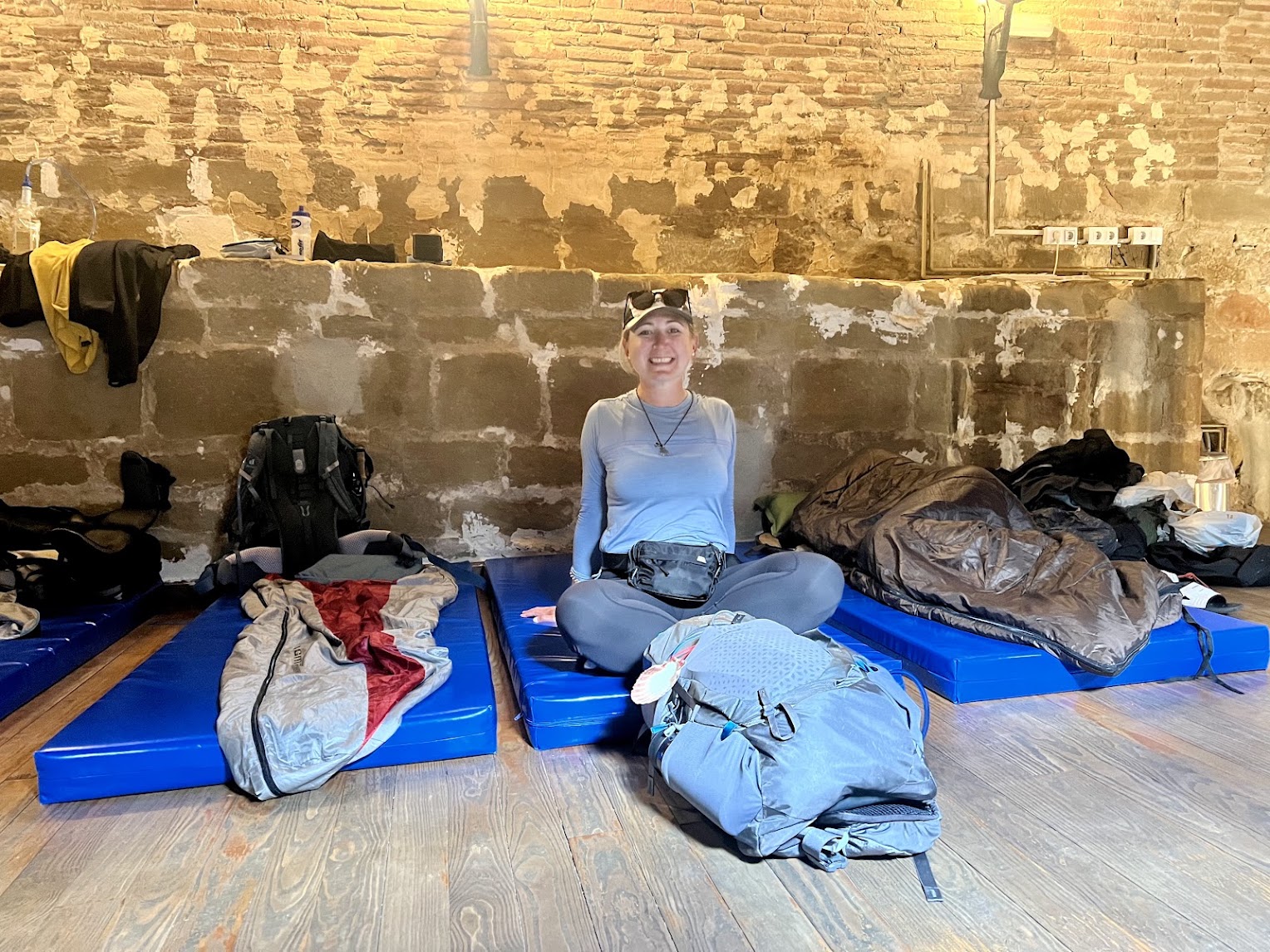
- Sleep System: You must first decide where you want to sleep on the Camino before you decide your sleep system. I knew I did not want the stress of relying on municipal albergues, and I had budgeted accordingly. Knowing that MOST albergues have blankets at least, and I didn’t want to carry the weight of a sleeping bag I might use 5% of the time, I brought a sleeping bag liner only. I 100% needed a liner in Borda, Roncesvalles and Granon.., and a sleeping bag would have made my life more pleasant in both Roncesvalles and Granon, but I was happy with my decision. Did I wear my coat to bed and use my towel as a blanket, and was still cold? Yes, I did, and yes, I was. But I’d make the same decision again to not have to carry a sleeping bag for 42 days that I needed twice.
- Hydration: I drink a lot of water. I read a lot about the pros and cons of a bladder, and I really didn’t like the idea of having to take it out of my bag and repack every time I filled it, or the risks of it leaking into my bag. On top of that, a bladder isn’t great for carrying around town when you’re done hiking for the day or keeping next to your bed in the albergue. On the pro side, having an easily accessible hose next to my mouth I thought was a good idea to make it easy to stay hydrated. I went with, what I think is, the best of both worlds and brought a Camelbak Eddy 32oz. and a Platypus Hoser I kept both in the external water bottle pockets of my pack, and used the Hoser mostly while walking and then the Eddy when stopped and in the albergue. It gave me roughly 2L of water if I knew there was a long stretch without a town.
- Swiss Army Knife: I never used this. But every pack list includes it, and of course, if I was going to bring one, I wanted the one with the corkscrew (for wine emergencies). I would bring it again, just in case, but I also kind of think it’s a dumb decision.
- Carabiners: I would skip these. A lot of people talked about how useful they are but I never used them.
Toiletries
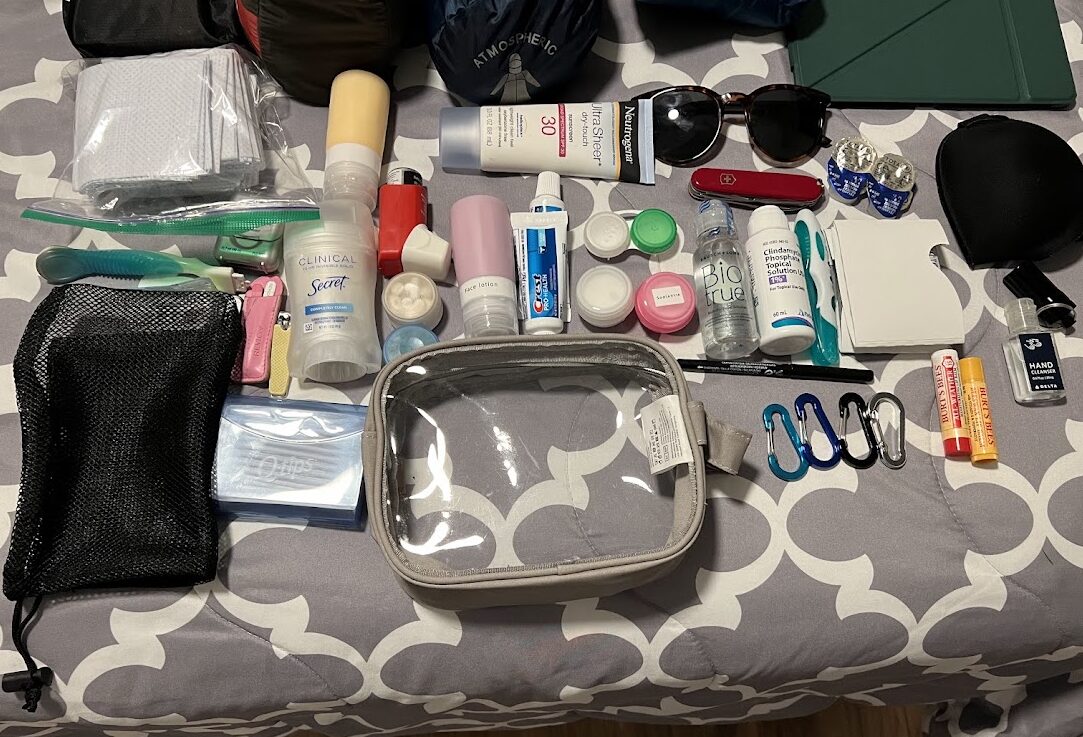
- Toothbrush: It didn’t save much weight but I bought this foldable toothbrush so that it fit in my small toiletry bag.
- Travel toothpaste: Just one travel size. Don’t bring extra, it’s the easiest staple to pick up as you go.
- SPF face cream: 2 oz SPF face moisturizer – decanted in a travel-size toiletry bottle
- Shampoo & Conditioner Bars: This deserves its own post that I’ll make some day. I tried SO many shampoo and conditioner bars, and I didn’t get it right on the conditioner for the first one, so I ended up buying a travel sachet every few days to a week. Now that I’ve found a shampoo and conditioner bar that I LOVE,I highly recommend bringing a bar instead of a liquid, especially if you’re like me and need to wash your hair every day. The shampoo bar doubled as body and face soap, and I stored both in the magical Matador Soap Case. This thing is crazy. You put wet soap in, it doesn’t get anything else wet, and it somehow dries while inside? Science.
- Sunscreen: I brought one of these Neutrogena Dry Touch Sunscreens and thought I would need to resupply for sure. But given I was wearing pants, a coat, and a hat most days, I didn’t need much sunscreen, and this stuff really lasts! I love that it doesn’t feel greasy going on. This lived in my fanny pack for easy access.
- Facewash: On the first Camino I brought Olay Face Wash Cloths. I like these a lot for short trips, but carrying these around for 42 days was kind of silly and I skipped them for the Portuguese route and just used my shampoo bar.
- Towel: I brought both a full-size travel towel and a travel washcloth, both ultralight, microfiber, quick dry towels. A lot of albergues where I shared a private room provided towels, but otherwise this was necessary.
- Q-Tips: Used the back for lopse band-aids.
- Razor: Gillette Venus Embrace, didn’t need any extra heads for the 6 weeks.
Personal Care:
- Kula Cloth: Historically, I have not been particularly skilled at the art of nature pees, so much so that, after a particularly embarrassing and damp experience in Nice, France, I gave up on the art entirely for about 15 years. I thought my body was not capable of an outdoor pee that did not involve pee-pants, and I was determined /hopeful that I would not need to prove this theory. On my first Camino, I successfully avoided any outside pees. I’m sure there were a few miles where the confidence to do so would have made me more comfortable, but instead I strategically planned my hydration in line with my bathroom stops. Between Camino 1 & Camino 2, I grew a lot as a person, meaning I successfully attempted an outdoor pee, and have since used this success to become a better human being, capable of overnight camping and not governed by my bladder’s need for indoor plumbing. All that to say, I now own and brought a Kula cloth, an environmentally friendly, anti-bacterial pee cloth, on the Camino Portuguese, and even used it once along the way (!!).
- Ultralight Triggerpoint “Lacrosse ball”: While I’m VERY VERY FAR from the old end of pilgrims, I’m still mathematically middle-aged(rude) and have to consider my body’s various weakpoints and likely injuries. I’ve been in PT for my achilles, my metatarsal, my iliopsoas. That lacrosse ball and I have seem some things. It was worth every bit of the 2 oz it weighed and my fellow pilgrims that borrowed it agree.
- Eyeliner. Don’t judge me; it makes me look like me.
- Deodorant: A small size of secret clinical lasted the whole way.
- Contact lenses / solution / case, one back up pair of contacts.
- Daily meds: – inhaler + allergy pills, melatonin and ibuprofen in 2 of these GoTubbs
- DIY First aid kit: needle & thread, tweezers, small nail clippers, Compeed, Bandaids. Compeed was a Camino training discovery. Ideally before you get a blister or when you get a hot spot, put a compeed over it. It sticks for a few days generally, and forms a little protective cushion around the area. It also has medicine in the pad. Important tip: before you ever put one of these one, learn how to take them off. If you actually have a blister, knowing how to take these off without ripping the thin layer of skin over your blister is critical.
- Glide Anti-Chafing Balm – a mini one of these that I used a few times on areas that got chafed from wet clothes.
Tech Stuff
- Power Adapter: I don’t recommend bringing anything that can’t be powered via USB-C or USB-A if you can avoid it. I use the Minix Power Adapter. I bought this a year or two pre-Camino to solve for a universal fast charger that could work for laptops, and it’s one of my most recommended products to international travelers. Weights very little, 100w fast charging, 3 USB-C and 1 USB-a port.
- Earbuds: If I’m being honest, I’m a little judgy of the pilgrims who are listening to audiobooks or podcasts all day. It’s probably the area of the Camino where I’m the most judgmental, and I’m sorry, That being said, small, light headphones are supremely useful, whether it’s to keep in touch, put on white noise next to a loud snoring bunkmate, or, listen to an audiobook. I used mine to send voice notes to friends and family during my walk, and, hypocritically, to listen to one audiobook during a few blister-filled, excruciating days of the Meseta.
- Kindle Scribe: This was my heaviest “luxury” item I brought. Discretionary is probably a better word. I wanted a book. I wanted a journal. I had been using the Scribe already for a few months, and it was pretty non-negotiable for me to bring. At this stage in my-husband-just-abandoned-me-without-warning process, I was journaling daily, and it was NECESSARY, I had a few Camino books I wanted to access, and the Scribe just made sense for me. But damn, I can’t wait till they make a lighter version.
- USB-C Cable (6″ and 18″) + a cool little Apple Watch Adapter so I didn’t have to bring a dedicated cable
- Powerbank – I used this Iniu Powerbank a few times on particularly long days, and a few times at hostels where I wanted to use my phone while it charged (and later left the battery charging during dinner). It’s USB-C in and out, so fast charges itself and has ability to fast-charge via USB-C and has USB-A ports. Small and light for how much power it holds.
Packing List
Pants:
Tops:
- Patagonia Capilene Cool Sunshirt
- Patagonia Capilene Cool Daily Tee
- Patagonia Capilene Cool Trail Tank
Underclothes:
- Patagonia Active Mesh Bra
- Patagonia Barely Everyday Bra – discontinued 🙁
- Lululemon Like a Cloud Bra
- 3 Metarino Merino Underwear
Shoes:
Socks:
- Smartwool Trail Run Cushion Crew Socks
- Stance Ultrlight Tab Socks
- Darn Tough Lightweight Cushion Socks
- Injinji Toe Socks
Outerwear:
Bags & Organization:
- Gregory Jade 33 (33 is discontinued)
- Fanny pack
- Mesh bags
Other Important Stuff:
- Leki Cressida Hiking Poles
- Sea to Summit Thermolite Sleeping Bag Liner
- Camelbak Eddy+ 32oz
- Platypus Hoser
- Swiss Army Knife
Toiletries:
- Kitch Shampoo & Conditioner Bar
- Matador Soap Case
- Toiletry Bottles
- Foldable Toothbrush
- Neutrogena Dry Touch Sunscreen
- PackTowel Travel Towel – Body
- PackTowel Travel Towel – Washcloth
- Gillette Venus Embrace
Personal Care:
Tech Stuff:
- Minix Power Adapter
- Kindle Scribe
- Jabra Elite Active 8 Earbuds – discontinued 🙁
- Apple Watch Adapter
- Iniu Powerbank